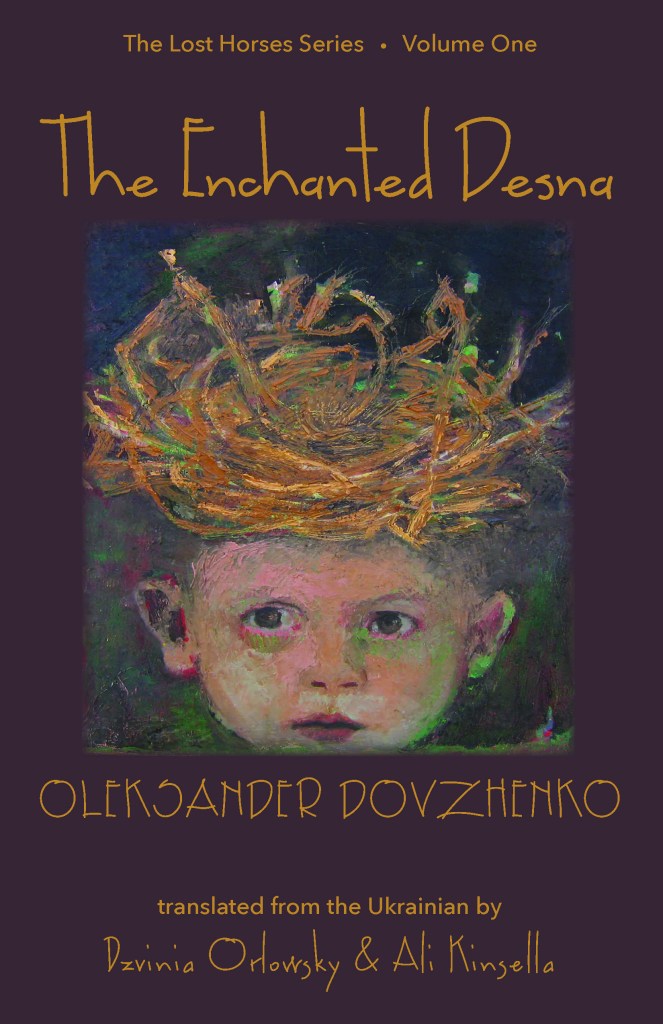
The Enchanted Desna by Oleksander Dovzhenko translated by Dzvinia Orlowsky and Ali Kinsella
Read an excerpt
A story told beautifully and movingly between the paintings of
Chagall and a movie by Béla Tarr, The Enchanted Desna is a rare
thing: a novelization-before-the-fact of a movie made after the
author’s death. The Ukrainian Oleksander Dovzhenko was per-
haps the greatest of Soviet film directors, with an imagination
that took in all the beauty of natural world and mankind’s toil
in it. He was also the most unfairly treated director of his gener-
ation, maligned and banned by Stalin. This superb translation of
his book can only arouse new interest in his masterful filmmak-
ing, still too unknown to Anglophone audiences.
—A. S. Hamrah, author of Algorithm of the Night and The Earth
Dies Streaming
Orlowsky and Kinsella’s brilliant translation of Dovzhenko’s mas-
terpiece carries us into the fascinating realm of Ukrainian rural
life in the early twentieth century. Keen-eyed and compassionate
Sashko vividly describes tender and terrifying family mem-
bers, quirky villagers, clueless clergy, and an array of charming
animals, including a rascally dog named Pirate. The dark and
whimsical humor, the scything swing of enchantment and disillu-
sion, allow us to experience rich folk traditions and a poor Soviet
agricultural economy endured through backbreaking labor, food,
drink, love and imagination. The Enchanted Desna is a powerful
testament to Ukrainian cultural identity and an important con-
tribution to world literature.
—Henry Hughes, author of Sergeant Dark, editor of River Stories
Oleksander Dovzhenko’s The Enchanted Desna is not just the au-
thor’s return to the headwaters of the great and picturesque river
of his childhood, on whose banks coexist the living and the dead,
humans and nature, the magic of a child’s gaze and the tragic bur-
den of history. It is a book about how the imagination, memory,
and love for one’s earth form a person and give them the strength
not to break even in the most trying of times and how individual
recollections become the emotional landscape of a nation.
—Halyna Kruk, Ukrainian poet, finalist for the 2024 Griffin
Poetry Prize
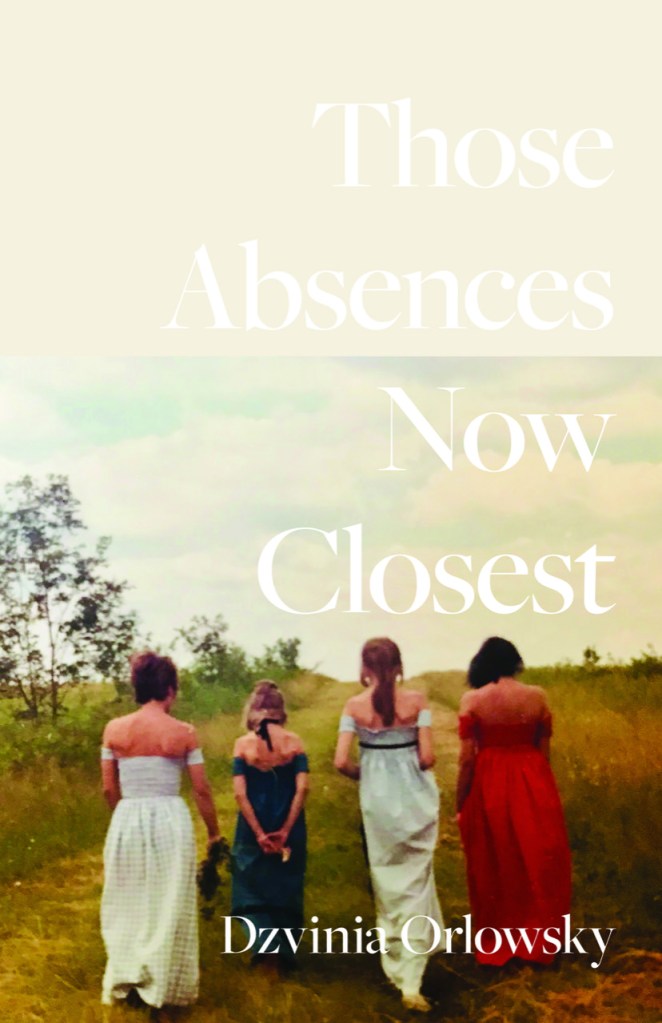
Those Absences Now Closest
Carnegie Mellon University Press, 2024
Cover Image: Miroslaus Orlowsky (Ohio, c. 1964)
l to r: Nadia Fedun (close family friend), Dzvinia, Maria (Dzvinia’s sister), Tamara (Dzvinia’s mother)
“Those Absences Now Closest documents, with adroit craft and virtuosity, not only ubiquitous human grief and cruelty but also war’s disastrous toll on the natural world: (‘ask the horse if it knows // to what peace your body rushed off // after the catastrophic fire.’) To this urgent, masterly testament of love and mourning, Orlowsky lends healing elements of family history, surreal struggle and surprise, and folkloric magic that bring to mind Chagall’s captivating paintings.”
― Cyrus Cassells
“Dzvinia Orlowsky’s sensitively attuned poems listen for the beating animal heart of absences wrought by war and exile. They ask, ‘what holds us / to the colorless burn // of family’ and who is keeping count of the dead when the homeland is far and no one reports the bombings anymore. Those Absences Now Closest probes into the ‘language of cold air, blank canvas of distance’ to report with lyrical precision what’s not on the news.”
― Mira Rosenthal
“How does poetry enter this age? Our times are reflected back to us in screens of dazzling triviality and paralyzing crisis. Dzvinia Orlowsky’s brilliant new book is a vision quest. Her work has the empathy and imaginative authority to literally inhabit generational trauma. There’s a visceral directness in the tension between Prolog and Epilog, in the haunted mesmerizing voice that can bridge village Ukraine, Putin, and Twitter America. Mythic, gnomic, contemporary as the war being fought in the whites of our eyes, Those Absences Now Closest is a capstone to a superb career.”
― D. Nurkse
Lost in Living
Poems by Halyna Kruk
Translated from the Ukrainian by Ali Kinsella and Dzvinia Orlowsky
Generously supported by a 2024 translation fellowship from the National Endowment for the Arts.
Finalist for the 2025 PEN America Award for Poetry in Translation

“Halyna Kruk is a poet of lyrical spells and musical whispers. Her human-scale voice confronts the inhumane historical landscape out of which she speaks insisting on a personal life, the life of a human heart and its ancient search for a bit of light in the dark.”
—Valzhyna Mort, Music for the Dead and Resurrected
“Lost in Living, a selection of Halyna Kruk’s breathtaking poems written during the escalation of the Russo-Ukrainian war paints haunting inner landscapes where dreams and reality’s multiplying shadows intertwine. A searing, lyrical, and timely meditation on loss, memory, death, and love, this deeply spiritual collection explores the poet’s dichotomy of emotions: “what’s wrong with us, why this confounding joy/to love this world, it’s enough to almost die/a few times,” “if death were a writer’s residency,/I would have applied long ago.” Masterfully translated by Ali Kinsella and Dzvinia Orlowsky, the poems act like a time machine, and Kruk’s alchemical self finds wonderment amid despair: “I’m still like a child/who got lost and found herself.”
—Hélène Cardona, Life in Suspension
“At its best, poetry expresses and even anticipates the times. Although Halyna Kruk tells her own personal story in her important collection, Lost in Living, a glimpse of the era in which she is living is always apparent and the brute facts of our recent history are never far from our reach in her haunting poems. Here, language is refined to express the essence of deeds and things, and her primary concern is for a deeply truthful telling of who we are and what the consequences are for our behavior in a post-modern world. In the hands of two deft and accomplished poet-translators, Kinsella and Orlowsky, who understand what Borges meant when he wrote that “the original is unfaithful to the translation,” Kruk comes alive in English, largely, I would argue, because of the translators’ ability and willingness to stay out of the way of these rich poems. This is literary translation at its best.”
—Bruce Weigl, Among Elms in Ambush and the forthcoming Apostle of Desire
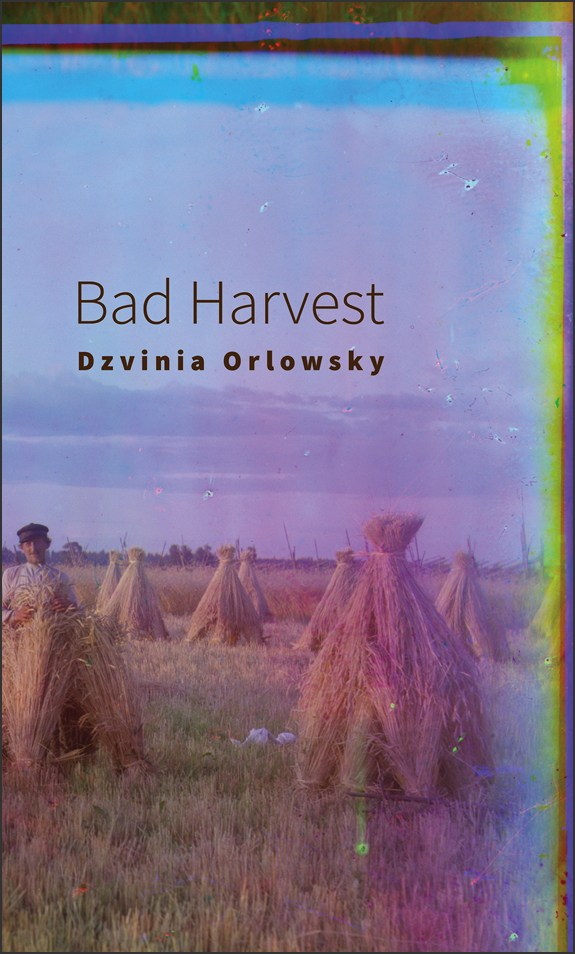
Bad Harvest
A Massachusetts Book Awards
2019 “Must Read” in Poetry
“Even after a bad harvest, there must be a sowing.” – Seneca the Younger
“Dzvinia Orlowsky’s sixth book, Bad Harvest, is the book that stakes her claim to an oeuvre, her own territory in American letters. Orlowsky’s voice is stunningly intimate, perhaps because these poems really look outward. Grounded in the funkiness of family love, marriage, the body in time, they turn to face history—our contemporary vortex, and the nightmares of Eastern Europe in the twentieth century.”
– D. Nurkse
“This collection simmers with the magical ingredients of an Eastern European medicine woman’s brew. Bad Harvest releases its potency poem by poem, entrapping and entrancing with its candor and Orlowsky’s deep-rooted intuitions and seductively quirky humor.”
– Mihaela Moscaliuc
“Like a hornet caught in a jar, there is our world buzzing inside Orlowsky’s prose poems, buzzing between words, yes, but also between silences. I started reading with these prose poems and couldn’t stop. And then: opened the village of her lyrics, where line-breaks’ bulging veins throb to a music all their own. Here, the streets are flecked with images, with feather and bone. Orlowsky’s is a world where the poet blesses all that is washed with saliva, all that has a pinch of salt. With these poems, the boring prose of reality we all want to escape is buried in a wake of hoofs. But what is this poet’s wisdom? Orlowsky looks back on this village of her days: Remember it, she says, for its silence // the hill where you staked your life. And what, exactly, do we take from it? She shows how to go on: Thank you doctor, / it must be so, each bone depleted–/each wish revealed. It is, indeed, revealing, beautiful work.”
– Ilya Kaminsky
Order online:
Powells.com
Amazon.com

